
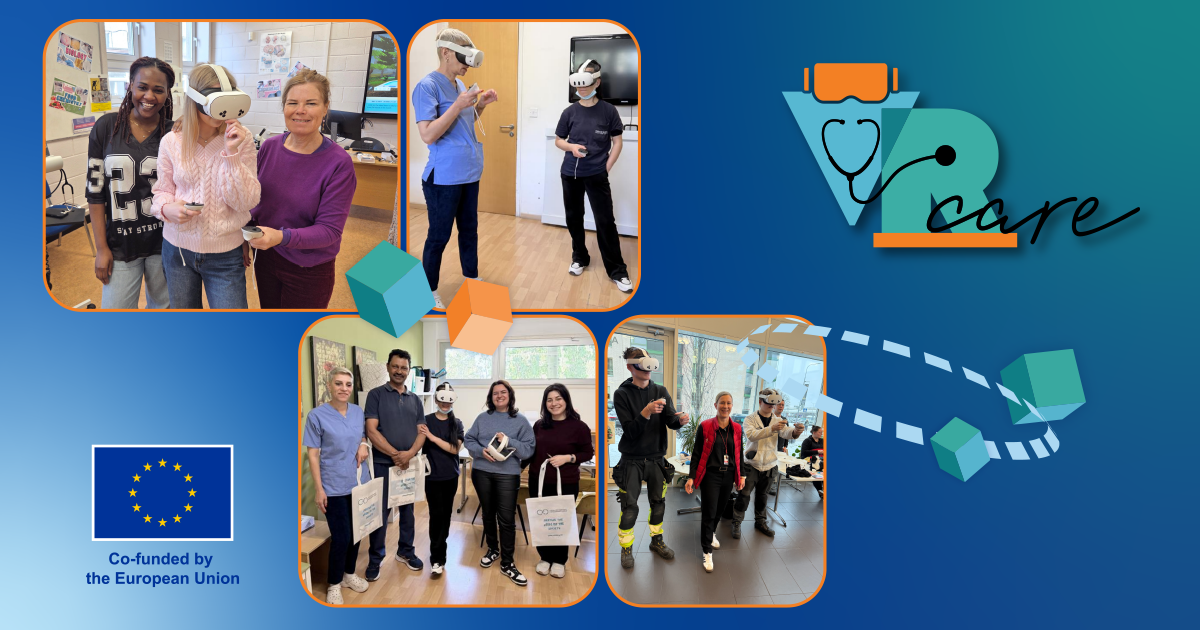
The VRCARE project has reached an important milestone with the completion of pilot activities across all project countries. Students, teachers, healthcare professionals, childcare practitioners and care organisations had the chance to test Virtual Reality scenarios in real educational and professional settings.
The pilots took place in Denmark, Finland, Spain, Ireland, Cyprus and Greece. They offered valuable feedback on how VR can support vocational education and training in the fields of health, welfare, childcare and elderly care.
VRCARE, “Modernizing Healthcare Pedagogy with Virtual Reality for Interaction, Ethics, Stimulation and Sensory” — Project Code: 2024-1-FI01-KA220-VET-000249151 — is co-funded by the European Union under the Erasmus+ KA220-VET programme. The project aims to modernise health and care education through immersive technologies that help learners practise realistic situations in a safe and structured environment.
Testing VR in real learning environments
Across Europe, the VRCARE pilots gave participants the chance to step inside realistic care scenarios. These scenarios focused on childcare, elderly care, communication, ethical decision-making, sensory engagement and person-centred care.
For many participants, this was their first experience with Virtual Reality as a learning tool. Instead of only reading about a professional situation or discussing it in theory, learners were able to observe, react and reflect from inside the scenario.
This created a safe learning space. Participants could practise difficult conversations, explore sensitive decisions and better understand the emotional and ethical dimensions of care work, without real-world risk.
A shared European testing phase
The pilots brought together a wide range of organisations and learning environments.
In Denmark, Spain and Ireland, students, teachers and care professionals tested VR scenarios linked to childcare, elderly care, communication and person-centred care. Participants highlighted the realism of the scenarios and their value in preparing learners for real professional situations.
In Finland, teachers and associated care organisations explored how VR can help learners understand ethical dilemmas and sensitive situations before entering work placements. The activities showed that immersive tools can make complex topics easier to understand.
In Cyprus, pilot activities took place in both childcare and healthcare settings. Educators and healthcare professionals tested scenarios that supported reflection on ethical choices, sensitive interactions and quality of care.
In Greece, teachers and students from several VET schools explored VR applications in the Health, Welfare and Wellbeing sector. The activities showed strong interest in using VR in vocational education, while also underlining the need for training, technical support and wider access to equipment.
What the pilots showed
The pilot activities showed that Virtual Reality can become a valuable tool for vocational education and training.
Participants responded positively to the experience. They found the scenarios engaging, realistic and useful for connecting theory with practice. Teachers and professionals also saw clear potential for using VR to support active learning, ethical reflection and professional skills development.
The feedback collected will help the partnership improve the scenarios and make the VRCARE tools more practical, accessible and relevant for future users.
Moving towards more immersive care education
The VRCARE pilots show that immersive learning can help bridge the gap between classroom learning and real professional practice. This is especially important in health and care education, where learners need not only knowledge, but also empathy, communication skills and ethical judgement.
The next steps will focus on refining the VR scenarios, improving usability and supporting the integration of VR into VET learning environments along with creating the next ones.
The results so far are very encouraging. VRCARE shows how Virtual Reality can support a more practical, reflective and human-centred approach to health and care education.
The pilot phase is more than a testing period. It is a strong step towards the future of vocational education in health and care — a future where learners can practise safely, reflect deeply and build confidence before entering real professional environments.
